According to iGaming Business, the following account is based on its reporting; these assertions are attributed to that source.
On October 26, 2026, iGaming Business reported that Denmark’s Gambling Authority, the Danish Gambling Authority (Spillemyndigheden), had launched a campaign about gambling-like features in children’s games. The outlet said the campaign aims to inform parents about such features in children’s video games and is called “Casino in the Children’s Room.” It also reported that the campaign promotes the StyrPåSpillet.dk knowledge platform. The report describes the launch and platform, but does not establish how many people the campaign reached or whether it changed behaviour.
The announcement raises a useful practical question for families: when does a game’s reward or purchase design deserve a closer look? The campaign’s reported subject is broader than the amount of time a child spends playing. This guide offers a way to think through that question without assuming that any particular feature is present in a game, that it is automatically harmful, or that it meets a legal definition of gambling. The examples below are general prompts for discussion, not details reported about the Danish campaign.
What “gambling-like” can mean in a game
The phrase describes a resemblance in the structure of an activity, not a conclusion about its legal status. A useful starting point is to separate three things that can appear together: a payment, an uncertain outcome, and a reward. Ask what the player gives up, what they are told they might receive, and whether the result is predictable before they make a choice. Those questions help make a design easier to understand without treating every purchase or prize as gambling.
For example, imagine a game offering a paid chance at one item selected from a collection. The player knows that a purchase is involved, but may not know which item will arrive. That hypothetical arrangement differs from choosing and buying one clearly identified item at a known price: in the latter case, the object of the transaction is specified in advance. This comparison is about transparency and uncertainty; it does not determine whether a particular product falls under a law or regulation.
Other questions can help reveal how a feature works. Is the result selected at random, or is the player selecting a known reward? Is the cost shown in ordinary money, in a game currency, or in both? Can a child see the price in real-world terms before deciding? Does the game explain the possible outcomes, or would a player need to search elsewhere to understand them? A parent can ask these questions even when the answers are not immediately obvious.
Look at the whole sequence, not just one button
A single screen may not explain the experience. It can be helpful to follow the sequence from the first invitation to the final result: what draws attention to the feature, what information appears before a decision, what action is required, and what the player sees afterwards. This is a practical observation exercise, not a claim about how any specific game is designed.
Consider whether the player is being asked to make a one-off choice or is being presented with a repeated cycle of decisions. Look for the point at which a cost becomes clear, and whether a player can pause to consider it. If several steps use different terms or units, ask whether a child can readily connect the choice to its cost. If the possible reward is uncertain, ask whether that uncertainty is made clear before the player commits.
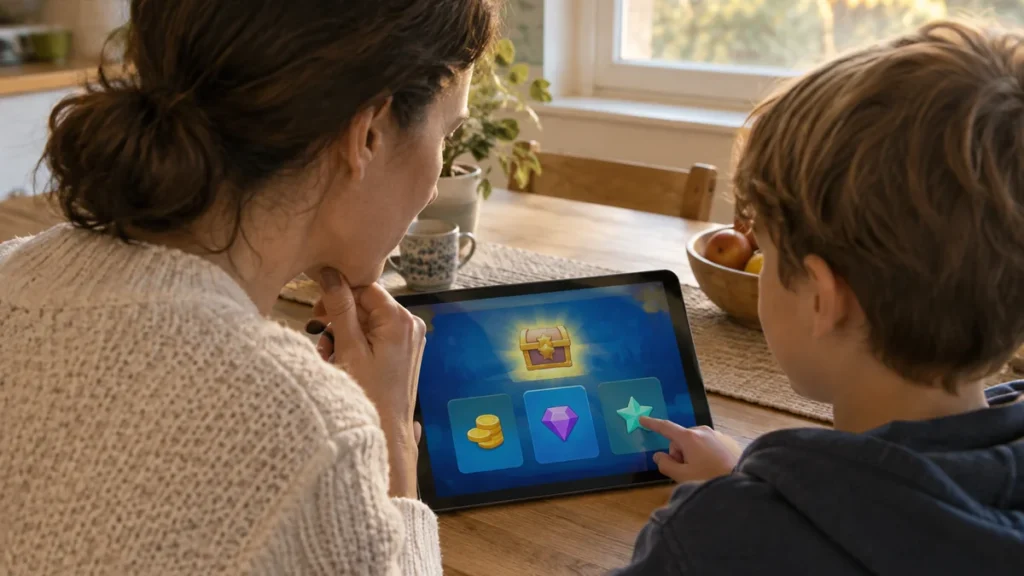
These prompts are useful because they focus on the player’s understanding. They do not require a parent to label a game as safe or unsafe based on a single visual cue. An animated chest, a spinning animation or a prize display, for instance, is not enough on its own to establish what a transaction involves. The relevant details are the rules of the interaction: whether money or another resource is required, whether the result is known in advance, and how clearly those conditions are presented.
How this differs from an ordinary game purchase
A straightforward purchase can be described in simple terms: the buyer sees the item, sees its price and chooses whether to obtain that item. A chance-based offer, as a general hypothetical, adds uncertainty about the result. A purchase using an in-game unit of value can add another step, because the player may need to work out how that unit relates to money or to other items. These are distinctions for examining a transaction, not a checklist that proves a game is gambling.

It also matters whether an activity is free to enter, what the reward is, and whether the player can exchange or transfer it. The campaign report supplied here does not discuss any of those mechanics, and this guide does not attribute them to the Danish authority or to StyrPåSpillet.dk. They are simply questions a family or reviewer may need to answer before drawing a conclusion about a specific feature.
Keeping these distinctions separate avoids two opposite mistakes. One is to assume that every game purchase is equivalent to a chance-based activity. The other is to assume that a feature cannot raise a concern because it appears inside a video game. A careful description comes first: explain the decision, the cost, the uncertainty, and the reward in plain language. Any legal or regulatory assessment is a separate matter.
Questions parents can use when discussing a game
- What is being offered? Ask the child to describe the item, reward or activity in their own words. Is the result known before a decision, or is it uncertain?
- What does a choice cost? Check whether the game shows a price directly or uses another unit. If the cost is not immediately clear, pause and work out what the player would need to spend before proceeding.
- What information appears beforehand? Look for an explanation of the possible outcomes and the conditions attached to the offer. If an important detail is missing or difficult to find, treat that as a reason to ask more questions, not as proof of a particular legal status.
- Can the child stop and decide later? Notice whether the feature allows time to consider a choice. A conversation can focus on whether the child understands what is uncertain and what they might give up.
- Is the game asking for a repeated decision? If the same offer appears again, discuss what changes from one decision to the next and whether the child can explain the cost and possible result each time.
- What would make the feature clearer? Ask what price, explanation or description would help a player understand the offer before acting. This turns the discussion towards comprehension rather than blame.
Parents do not need to settle every technical or legal question during a conversation. They can start by asking the child to show how the feature works, read the information together and identify anything they cannot explain. If the game’s presentation leaves the cost or outcome unclear, that uncertainty itself is worth discussing. The aim is to understand the interaction, rather than to infer facts about it from a name or animation.
Questions for developers and reviewers
The same framework can be used when examining a design. A reviewer can map the path from invitation to outcome and record where the player learns the price, what the possible results are, and whether a purchase or other resource is required. A developer can ask whether those details are visible at the moment they matter, rather than relying on a player to infer them from a symbol or a separate screen.
Clarity is easier to assess when the elements are considered together. A stated price may be less informative if a player must first convert an unfamiliar unit; a list of rewards may be difficult to interpret if it does not make clear how the result is chosen. These are design questions, not claims that all games use such systems. They can help teams describe a mechanic precisely and identify where a player may need more information.
Reviewers should also distinguish observation from conclusion. They can document what a player sees and does, while separately seeking the relevant legal or regulatory interpretation. That separation helps prevent a general discussion of resemblance from being mistaken for a finding about a named game, company or authority.
What the Danish campaign report does—and does not—say
In its report dated October 26, 2026, iGaming Business described a Danish Gambling Authority campaign named “Casino in the Children’s Room.” According to the outlet, its stated aim is to inform parents about gambling-like features embedded in children’s video games, and it promotes the StyrPåSpillet.dk knowledge platform. These are the verified details available here about the initiative.
The report does not establish the campaign’s audience, reach, effects or subsequent activity. Nor does the information provided describe particular game mechanics, give a legal test, or explain the contents of the platform. It would therefore be premature to claim that the campaign has already changed parental awareness, altered game design or produced any specific outcome. The name and reported focus indicate the subject of the initiative; they are not evidence of its impact.
For families, the practical takeaway is to examine the mechanics rather than rely on labels: identify any cost, determine whether the outcome is known, and check what the player is told before making a choice. For developers and reviewers, the parallel task is to make those elements describable and assessable. Denmark’s reported campaign provides a dated example of public attention to the subject, while the questions above remain a general framework—not a summary of campaign guidance or a verdict on any game.